Dorset day one, 15 Oct 2010
Day one Itinerary
|
13:00 |
Lunch at Dorchester |
|
14:00 – 16:00 |
Visit to Dorchester Museum |
|
19:00 |
Talk and Dinner with Alan Holiday, Chairman Dorset RIGS. Alan will be the “Resident Expert” throughout our visit. |
Write up of day one by Gren Gaskell
On the way to Weymouth the geology expedition stopped for lunch and comfort at Dorchester. This welcome interruption to our journey presaged the exiting and informative three days to follow as the museum in this small town was worth a visit in itself. The wealth of exhibits were delightfully displayed and explained. Dorset is not just a world centre for geological discovery but has, in addition, many treasures from the evolution of civilisation. Three hundred and eighty two Bronze Age axes were found in 2007 in a cache buried two thousand eight hundred years ago and there were lots of other finds on view. The county is obviously proud of the fact that it was Mary Anning, a Dorset woman, who realised the importance of the material she saw and put together to discover the first evidence of a prehistoric creature. This as late as the beginning of the nineteenth century. Our computer, on inspection of the name Anning asked to alter it to annoying, and wasn’t she just that to the people who had been led to take the Bible literally and believe the world was less than five thousand years old. A startling fact to the Gaskells was the information that we have only been an island for seven and a half thousand years, much less than a blink in the time span of the geology we were on the way to see on the Jurassic coast. We were introduced to Alan Holiday, our geologist accompanying us for the next three days, and were all infected by his enthusiasm as we enjoyed a slide show talk on our first evening. Was it designed as a hook for the course? If it was, it worked.
Pictures from Dorchester Museum
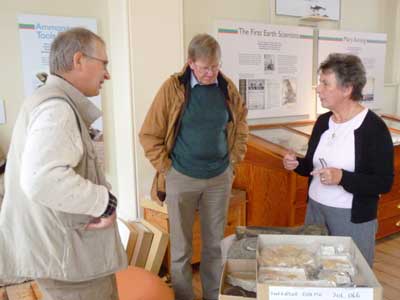
Our guide to Dorchester museum, with Richard and Alan
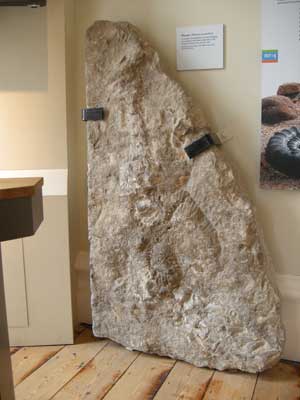
Preserved bones at a Pliosaur in Portland Limestone (143 million years old).
A number of backbones and ribs are preserved in the limestone. This give us an idea of the huge amount of work required to turn this piece of rock into the specimen below.
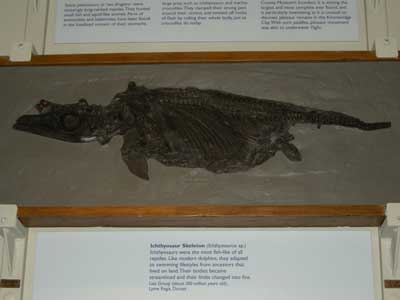
Icthyosaur. Lias group, 200 million year old, Lyme Regis.